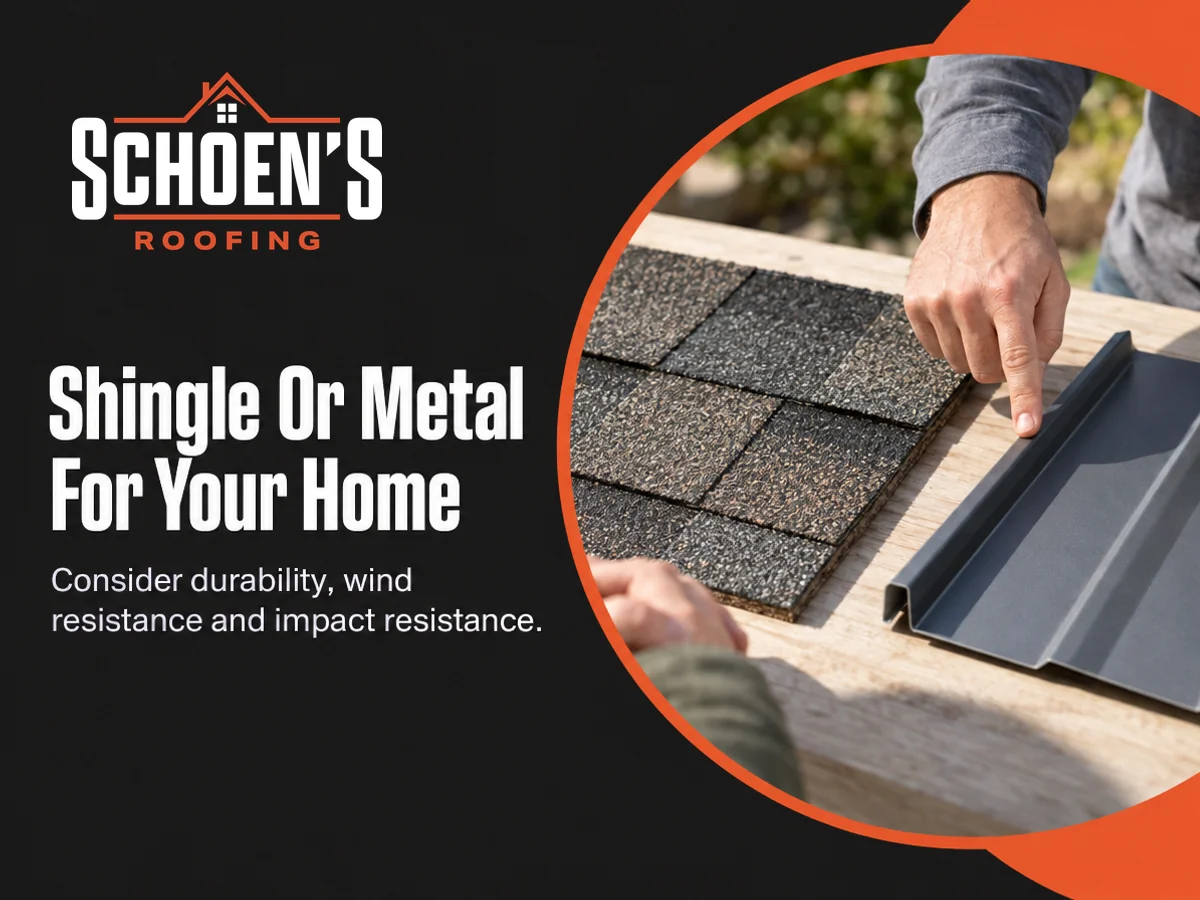
The two roofing materials we install most are architectural asphalt shingles and standing-seam metal. Homeowners ask which is better, and the honest answer is that it depends on your budget, how long you plan to own the home, and how much hail your area takes.
Here is how they compare for homes across Nebraska and western Iowa, including Council Bluffs and the Omaha metro.
Side by side
| Architectural asphalt | Standing-seam metal | |
|---|---|---|
| Typical installed cost, full roof | About $9,000 to $22,000 | About $14,000 to $40,000 |
| Expected life in our climate | 25 to 30 years | 40 to 60 years |
| Large hail | Bruises and cracks; a hard season can end it early | May dent cosmetically, rarely fails structurally |
| Maintenance | Periodic inspection, reseal penetrations | Very little; no exposed fasteners |
| Best for | Lower up-front budget, shorter ownership | Long ownership, lowest cost per year |
The price ranges are for a typical home. Roof size, pitch, tear-off layers, and complexity move the number.
Up-front cost
Asphalt wins on the sticker price, and for many homeowners that gap decides it. Architectural shingles are a proven, sound choice, and our residential roofing crews install more of them than anything else. Standing seam costs more because the panels, trim, and labor are all more involved.
Lifespan and cost per year
Over time, metal flips the math. A shingle roof lasting 25 to 30 years and a standing-seam roof lasting 40 to 60 are very different purchases. If you plan to stay in the house for decades, metal often costs less per year of service despite the higher price. If you might sell in ten years, the next owner gets most of that benefit.
Hail: the question that matters most here
Standard asphalt shingles bruise and crack under hail, and a single hard storm season can end a shingle roof early. Metal can dent under large hail, but it rarely fails structurally. Impact-resistant Class 4 shingles sit between the two, holding up far better than standard asphalt at a smaller premium than metal. Our guide to impact-resistant shingles covers that middle path in detail.
Council Bluffs shares storm systems with eastern Nebraska, so hail is a real planning factor on both sides of the river. Some insurers treat impact-resistant roofing differently, so ask your agent how your policy handles it before you choose.
Wind and maintenance
Both materials handle Plains wind well when installed correctly, and that qualifier matters. Standing seam has no exposed fasteners to back out, so it needs little upkeep. Asphalt benefits from a periodic roof inspection to reseal penetrations and reset any wind-lifted courses before they leak.
Is a metal roof loud?
This is one of the most common worries. Over solid roof decking with underlayment and an insulated attic, rain on a standing-seam roof is not dramatically louder than rain on shingles. The loud metal roofs people remember are usually on barns or sheds with no decking underneath. If noise is a concern, ask how the roof will be installed over your existing deck.
Snow and ice
Metal sheds snow more readily than shingles. That can be a plus, but it also means snow can slide off in sheets. Over entries, walkways, and lower roofs, snow guards may be worth discussing. Asphalt holds snow longer, and both materials still depend on good attic ventilation to limit ice dams.
Which should you choose?
- Choose asphalt if up-front cost matters most or you may not own the home for decades.
- Choose metal if you want the longest service life and the lowest long-term cost per year.
- Consider impact-resistant shingles if you want a middle path in a high-hail area.
There is no single right answer, only the right one for your home and how long you will own it.
What to ask on a quote
- Which product line, panel profile, or shingle class is included?
- Is full tear-off included, and how many layers are being removed?
- What underlayment and ventilation are specified?
- Are snow guards, trim, and flashing details on the quote?
- What warranty covers materials, and what covers workmanship?
Get written numbers on both
We will give you written numbers on both options so you can compare them side by side. For the full breakdown, see our guide to roof replacement cost. If standing seam is on your list, learn more about our metal roofing in Council Bluffs and across the region. Schoen's is a family-owned roofing contractor in Council Bluffs with an office on Norwood Drive and free inspections.
FAQ
Is metal roofing worth it in Nebraska and Iowa?
It often is if you plan to stay in the home for decades. The higher up-front cost is spread over a much longer service life.
Does hail ruin a metal roof?
Large hail can dent metal, but it rarely causes structural failure. Standard asphalt is more likely to need replacement after a severe hail season.
What are Class 4 shingles?
Impact-resistant shingles rated to hold up better against hail than standard asphalt. They are a common middle option in hail country.
Can you put a metal roof over shingles?
It depends on the roof, local code, and the manufacturer's requirements. We will tell you after an inspection whether tear-off is needed.
Do you install metal roofs in Council Bluffs?
Yes. Schoen's installs standing-seam metal and architectural asphalt across Council Bluffs, Pottawattamie County, and the wider region.